Gulen Schools Worldwide

Gulen Schools Worldwide
Restore the Ottoman Caliphate. Disclaimer: if some videos are down this is the result of Gulen censorship which filed a fake copyright infringement to UTUBE.
Showing posts with label gulen worldwide. Show all posts

Saturday, December 10, 2016

3 Gulen Schools in Benin, Africa agree to close down Gulen FETO teachers

    Benin to shut down FETÖ-linked schools

DAILY SABAH WITH ANADOLU AGENCY
ISTANBUL
PublishedDecember 6, 2016
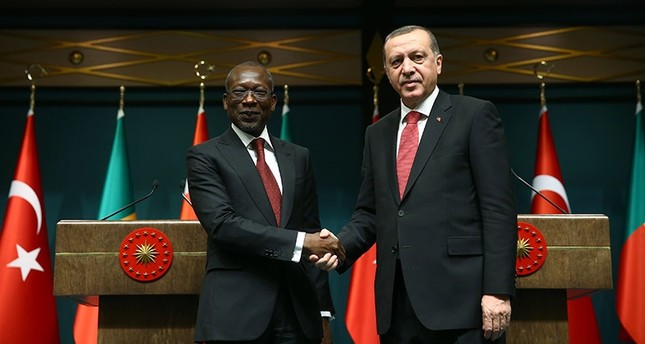
Turkish President Erdoğan meets Benin President Patrice Talon in the Presidential Complex in Ankara on Dec. 6, 2016. (AA Photo)
Turkish President Erdoğan meets Benin PresidentPatrice Talon in the Presidential Complex in Ankara on Dec. 6, 2016. (AA Photo)
President Recep Tayyip Erdoğan announced in a press conference held in Ankara on Tuesday that Turkey and Benin have agreed on shutting down three schools linked with the Gülenist Terror Group (FETÖ) operating in the West African country.
The decision was made during Erdoğan's meeting with his Beninese counterpart Patrice Talon who was paying an official visit to Ankara.
Over the past weeks, similar arrangements against FETÖ-linked schools have also been made by other African countries including Sudan, Somalia, and Guinea.
Turkey signed a protocol Nov. 18 with Chad for the transfer of all FETÖ-linked schools there to Turkey's Maarif Foundation.
FETÖ is the terror group behind the failed July 15 coup attempt in Turkey and a string of crimes including two previous attempts to overthrow democratically-elected governments, money laundering, sham trials and imprisonment of its foes thanks to its infiltrators within the police and judiciary systems.
FETÖ runs a global network of schools from Africa to Central Asia, where it recruits more followers into the group.
During the conference, Erdoğan also said that Turkey gives a lot of importance to its relations with Africa, noting that approximately 4,500 African students from 54 different are currently studying in Turkey.
The President added that five different agreements had been signed between Turkey and Benin.
"All [African] countries matter to Turkey, thus, I think, our ties with Africa should be strengthened much more in order to keep this friendship and solidarity together," Erdoğan said.
Both parties also talked about the Turkish embassy in Benin. Erdoğan said that Talon reminded that the embassy building is currently rented, and suggested to reserve a new building site in a better location. Answering positively to the suggestion of Talon, Erdoğan said that the process could be accelerated with the cooperation of both sides.
Talon said Benin has a lot to learn from Turkey which he said is "a rising power."
On a possible visit to Benin by Erdoğan, Talon said: "It will be a very good news for the whole south of Saharan [countries] and it will indicate the cooperation. Maybe many African countries will feel jealous. Because we, as all African countries, admire Turkey."
Turkey, currently having 39 missions across the African continent, aims at having 54 diplomatic missions in 54 African nations to set up stronger ties with the continent.

Sunday, March 9, 2014

Gulen Movement in France how powerful are they?


The confrontation between Islamists, led by the Prime Minister Recep Tayyip Erdogan against the Gülen movement has repercussions in France where this little known organisation counts several thousands of followers.

On this day of April 2007, on the banks of the Bosphorus, a small group of French people are engaged in a heated debate. Some of France’s well-known intellectuals are present: the historians, Jean-Pierre Azéma, Philippe Roger and Olivier Wieviorka, Olivier Roy a specialist on Islam, the former superintendent of the Catholic Institute of Paris Joseph Maïla, the philosophers Dominique Bourel, Michel Marian, and Joël Roman, the geographer Michel Foucher, the editor Jean-Louis Schlegel, Frank Debié a specialist in Political Sciences…

They were invited to Istanbul to debate with Turkish academics and intellectuals in a luxury hotel [1]. The topic ? ‘The Republic, cultural diversity and Europe’.

This is what is troubling the small group: were they right to accept this invitation? At the origin of this question : the dinner on the first night at the Dolmabaçe Palace, where alcohol  was forbidden, and more importantly, the contents of the presentation brochure placed on the nightstands in the hotel rooms. ‘Did you read the demonization of blasphemy it contains? cried out Phillippe Roger, particularly vigilant and watchful. We have accepted the invitation of a society which criminalizes blasphemy…’

Indeed, as the French intellectuals just discovered, behind the ‘Abant platform’  which gave out the invitations, there is the large Gülen Neo-Brotherhood which ‘often does not present itself as such, and puts forward key figures who are not always members of the society’ explains Olivier Roy to his peers.

A two level movement

In the last couple of years, this neo-brotherhood has appeared as a two level  movement.

On the one side, a vast network of pious and very active Turkish Muslims, involved and devoted ‘to serve’ (Hizmet in Turkish) civil society. Inspired by the thought of the imam Fethullah Gülen who is living in exile in the United States since 1999, they condemn violence and terror; promote entrepreneurship, education and interreligious dialogue.

On the other, a strong presence, a ‘core group’ according to some observers, at the heart for the police and the justice system, which allied to the Justice and Development Party (AKP) in power since 2002, helped the Turkish Prime Minister Recep Tayyip Erdogan to get rid of de political wardship of the army through hundreds of arrests and sensational trials.

The movement is established in 150 countries, including France since the 80s – incidentally, Fethullah Gülen visited Paris and Strasbourg in 1990. Europe in contrast to Africa and Asia has so far not constituted a priority for the movement. However, in the last ten years the latter has quickly grown.

Since 2007, other guests have followed the steps of our Parisian intellectuals: academics, councillors, journalists, activists…Many French people discovered Turkey thanks to this peculiar ‘sponsor’. How many exactly? ‘We do not keep such records’ answers Nihat Sarier, the president of the Parisian Platform, who defines his society as ‘a centre for reflexion, debate and social action inspired by the ideas of Gülen’, before admitting  ‘it is true that it organised several thematic trips to Turkey, focused on secularism, minorities’ rights, women’s rights, in partnership with French institutions’.

Just recently, in December 2013, during a dinner at the National Assembly, a French MP praised the appeal of the town of Konya which he had just discovered thanks to the society.

To this day, only one academic has published a study which begins to seriously consider the Gülen movement in France: Erkan Toguslu, researcher in anthropology, who holds the Gülen Chair for intercultural studies at the Catholic University of Louvain in Belgium and who dedicated a chapter of the book he coordinated Société civile, démocratie et islam (L’Harmattan, 2012) to movement’s educational experience in Paris.

Not easy to define

One has to admit the movement is not easy to define. With its determination to get involved in the public sphere with secular motivations, it has something of the Freemasons and the Jesuits. Yet, the diversity of the activities it proposes makes one think more of the Rotary. From all of these it takes a taste for secrecy – or prudence – which provokes suspicion and brings to mind the Opus Dei.

With its religious basis, its prayer circles, it places itself in a Turkish (and Muslim) tradition, that of the tarikat (brotherhoods), while at the same distinguishing itself by its openness to the world and its involvement in civil society.

The structure of the movement, floating and lose, is based on strong personal relations, sometimes volunteers, and very decentralised more than pyramidal.  The funding of its activities is based on the anonymity and discretion of himmet (monetary donations in particular during the month of Ramadan) which does not make it very transparent. In France, ‘Muslims are perceived either as terrorists or unemployed. Fethullah Gülen’s message allows us to live our faith while getting involved in society and gives us back a certain pride’, explains one of its members.

In 2009, the most active members had nonetheless made efforts to gain exposure. ‘However, they remain relatively mysterious’,  according to the political scientist Louis-Marie Bureau who studied the ideas of the one who inspired them and who has been  criticised by some of its followers who did not appreciate one of his articles. ‘As a general rule, they are completely sincere in relation to the laws of the Republic even though their speech in France has nothing to do with the one they put forward in Central Asia or in Azerbaijan – where they easily invoke ‘Pan-Turk’ links whereas in France, they place the emphasis on citizen responsibility and secularism. Yet, they think that presenting the movement as monolithic could create difficulties for them. That is why they remain vague about their links to Fethullah Gülen.’

‘I have nothing to hide. I accept completely that I be presented as a follower of Gülen and his ideas, but my life does not limited itself to that. I retain my critical thinking which is why I cannot stand it when people call us ‘Gulenists’, clarifies Emre Demir, head of Zaman in Paris, the movement’s Franco-Turkish newspaper which is printed every week.

‘House of light’

There would be among the members of the Gülen movement in France tens of students, including a little less than ten Turkish or Franco-Turkish doctoral students – among which a few girls. To obtain a scholarship, sponsored by Turkish entrepreneurs living on French territory, one must agree to have the family’s budget examined in minute detail. Expenditures deemed excessive, a car, holidays can quickly get the candidate eliminated.

In France like in Turkey, the students who are sympathizers of the Cemaat (an other name for the movement, means communauty)  often form a group to share an apartment, also known as a ‘house of light’. A spiritual community which satisfies some while others denounce the risks of indoctrination.

In private, several French academics praise the ‘diligence, proactivity, conscientiousness and thoughtfulness’ which characterise these young people. In the last couple of years, numerous students have started working on the Gülen movement, but a great many of them share its ideas which could in the long term distort the studies on the subject. ‘Research on the movement is dominated by students who are close to it and the latter sponsors their fellowships. Not to mention that a researcher who has not received the movement’s approval will find it very difficult to have access to the schools, the activists, etc’, notes a French researcher in Political Sciences Elie Massicard, linked to the Ceri (Centre for the study of international relations).

The two schools, in Villeneuve-Saint-Georges and Strasbourg, founded by families who are supporters of Fethullah Gülen count less than 300 students in total. They are for the moment private schools independent from the state, funded by donations and the school fee (5.000 euro per student per year), each of which represent half of the school’s total funds.

In addition to these institutions, there are around twenty societies which provide ‘support in the social and educational field’. Finally, the movement organises ‘dinners to live well together’, sometimes in partnership with French associations such as the Red Cross or the Restos du Coeur as it was the case on January 11 of this year at Clichy-sous-Bois.

The choice of integration

Since 2010, another big event of the ‘living together’ initiatives, organised and sponsored to a great extent by societies of the Gülen movement is the Festival of Franco-Turkish Culture. Its objective explains one of the organisers is ‘to help young Franco-Turks who are interested in French regional culture to gain active citizenship.’ This year a regional final took place on 22 February in Strasbourg in the presence of the mayor of the city, Roland Ries (Socialist Party), and several officials.

Furthermore, Platform Paris offers many conferences and debates on questions crucial for French society, often little discussed in other circles. This meeting, for example, at Pantin on 18 October 2013 between Tareq Oubrou, chancellor of the Great Mosque of Bordeaux , and the priest Christophe Roucou, head of the National Service for the Relations with Islam in the Catholic Church; or the one on 31 January of this year, with Kamel Meziti, author of the Dictionnaire de l’islamophobie.

Transnational, the Cemaat has chosen to promote integration in the host country of which it adopts the norms and rules. With its strong Turkish roots, it needs, in order to expand itself in France, to attract immigrants, or French citizens of North African origins with whom Turks must not be confused specifies Abdurrahman Demir, the head of the school in Villeneuve-Saint-Georges:
‘What makes us different from North Africans is the fact they are turned away from their culture because the message of their imams and their parents does not correspond to the realities of contemporary life. As a result they become frustrated and violent.  Whereas us Turks, move forward with our culture, our history, and thanks to the Gülen movement we do not retreat into solitude.’


Links with the American religious right

If the ‘Gülen transplant’ has trouble taking roots in France, it is maybe because there is something very American about this movement where the cultural merges with the religious.  ‘There are ideological links between Fethullah and the American religious right’, describes the academic Jean-François Bayart who went to present his book on republican Islam at Platform Paris and who evoked in an article the links the Gülen movement supposedly maintains with the CIA.


READ Entire story here http://arianebonzon.fr/turkish-gulen-movement-france/


Tuesday, December 17, 2013

Gulen Movement to take over Academy in England?


Parents are being informed of a plan to make The Warriner School and two primaries an academy, sponsored by a Turkish-backed organisation.

The primary schools are Sibford and Hornton. Parents have been sent letters by Warriner head teacher Dr Annabel Kay and chair of governors Mandy Morris extolling the virtues of the plan and an open meeting was held to answer questions.

The organisations involved, BAU Foundation and Mentora Academies Trust, are new and were only accepted and registered with the Department for Education (DfE) in August.

If the schools leave Oxfordshire County Council – the local education authority (LEA) – they will be funded centrally. It is not known how much the allowance will be but the Mentora Academies Trust will give the academy a ‘token’ £150,000 a year and it is understood the academy would be better off.

Dr Kay, an unpaid director of the BAU Foundation, said: “This is an exciting opportunity to access national best practice to support all our schools in providing the very best outcomes for all our children.

“The directors are a group of highly-skilled people who want to work with us to be the very best we can.”

Academies organise and pay for their own management and administration with input from their sponsor and can reorganise pay scales and conditions to suit their priorities.


Monday, April 15, 2013

Gulen Movement talk at Berlins Humboldt University met with protest


25 left-wing and Kurdish activists protested against an event about the Gülen movement in the Humboldt University. This was held at the library with about 150 participants. The protesters say the movement is nationalistic and anti-Kurdish.

Gulen Movement under investigation in the Netherlands

Is Gulen crying because so many countries want his shit head followers to leave?


In no country has the Fethullah Gülen movement become more of a political issue than in The Netherlands. A television item in 2008 resulted in questions in parliament to the Minister of Social Affairs about a possible negative influence by the movement on the integration of Turks in Dutch society. Subsequently the movement was investigated by the Dutch intelligence organization AIVD. The AIVD did not recognize a threat to Dutch society.

Later on the government assigned academician Martin van Bruinessen to write a report on the activities of the Gülen movement in The Netherlands. Van Bruinessen presented much relevant information, but in his conclusion he considered that the movement did not present a danger to integration. The minister went along with this conclusion, resulting in the continuation of subsidies by the government for the Gülen movement. Many disagreed with this position. Probably to limit further suspicion the Gülen movement announced the closure of dormitory schools, which were especially seen as a threat to integration.

Subsequently media and politics became silent about the Gülen movement for some time. However, recently a new controversy developed. It started when the current Minister of Social Affairs, Lodewijk Asscher, announced the investigation of three Turkish religious organizations: Süleymanci, Milli Görüs and Diyanet. Member of parliament for the Socialist Party (SP) Sadet Karabulut was among the ones who wondered (through twitter) why the Gülen movement was not included in this probe.

On the 30th of March the situation gained momentum when the Dutch opinion website joop.nl revealed that Minister Asscher would be present at the launch of Zaman Vandaag, a new weekly magazine which is part of the Gülen movement. Joop.nl also pointed to the negative remarks about integration by Zaman Vandaag editor-in-chief Mete Öztürk during an interview with a Belgium based Magazine.

Last Friday the Dutch news show Nieuwsuur revealed that small dormitory schools of the Gülen movement are still active in the Netherlands and that young children are intensely confronted there with the ideas of Fethullah Gülen. The isolated character of these places once again lead to the question of whether the Gülen movement is harmful with respect to integration. Nieuwsuur also revealed that Gülen sympathizer Köksal Gör, a Turkish member of the Dutch liberal party (VVD) who is active in local politics, was managing these small dormitory schools.

There were several consequences. The VVD asked Köksal Gör to resign from his position as local administrator and Minister Asscher made a statement that he had reconsidered his decision to be present at the launch of the weekly Zaman Vandaag. He also said that not three, but four Turkish organizations will be investigated, suggesting that the Gülen movement will be a target of a new governmental investigation. A statement on the website INS Platform of the Gülen organization shows that the followers of Fethullah Gülen in the Netherlands are far from amused by the developments last week. Explainable, since the subsidies to their movement by the government may be at stake in the near future.

# # # #

Monday, March 25, 2013

Gulen School in Ethiopia opens dormitory

The ground breaking ceremony of a new 150-bed capacity high school dormitory for Ethiopian-Turkish schools’ Alem Gena campus was held in Ethiopia.


In addition to Turkish businessmen residents of Ethiopia, Turkish Ambassador to Addis Ababa Kenan Ipek was in attendance at the ceremony. Ipek said “What distinguishes us from other nations is that we do not seek self-interest but sharing, just like what we witness here today.”

The ground breaking of the building followed the remarks. Afterwards, Ambassador Ipek planted a tree in the soon-to-be dormitory’s yard. The construction financed by Turkish businessmen and entirely supervised by Turkish engineers is planned to be completed by July 2013.

NOTE: This school was financed and constructed by Turkish businessmen (aka TUSKON)  and only by Turkish engineers.  They plan on staying in Christian Ethiopia long enough to rape the land and destroy the Christian population. 

Saturday, March 2, 2013

Gulen School in Ukraine


Spouse of Recep Tayyip Erdogan, Emine Erdogan with delegation that included Turkish ministers and other high officials visited Gulen-inspired school in Ukraine. The school, International Meridian College was established in Kiev by Turkish and Ukrainian entrepreneurs. At the moment, the school, which gives education in English, Turkish, Russian and Ukrainian languages, is considered to be one of the most prestigious educational establishments in Ukraine. Students organized concerts and shows for the high guests from Turkey. Emine Erdogan admitted that she was very happy about the success of the school established by her compatriots and was very glad to be accepted with such warmth and hospitality by the school’s staff and students