Gulen Schools Worldwide

Gulen Schools Worldwide
Restore the Ottoman Caliphate. Disclaimer: if some videos are down this is the result of Gulen censorship which filed a fake copyright infringement to UTUBE.
Showing posts with label Gulen Schools Africa. Show all posts

Monday, July 30, 2018

Republic of Turkey opens school in South Africa

Books are the strongest instruments to fight against cultural corruption,” said the Turkish First Lady Emine Erdoğan. She was speaking at the inauguration of a Tika-erected library at the Houghton Muslim Academy (HMA) on July 27. The library is one of many other Turkish-government backed development aid projects that have cropped up across the country in the past years.
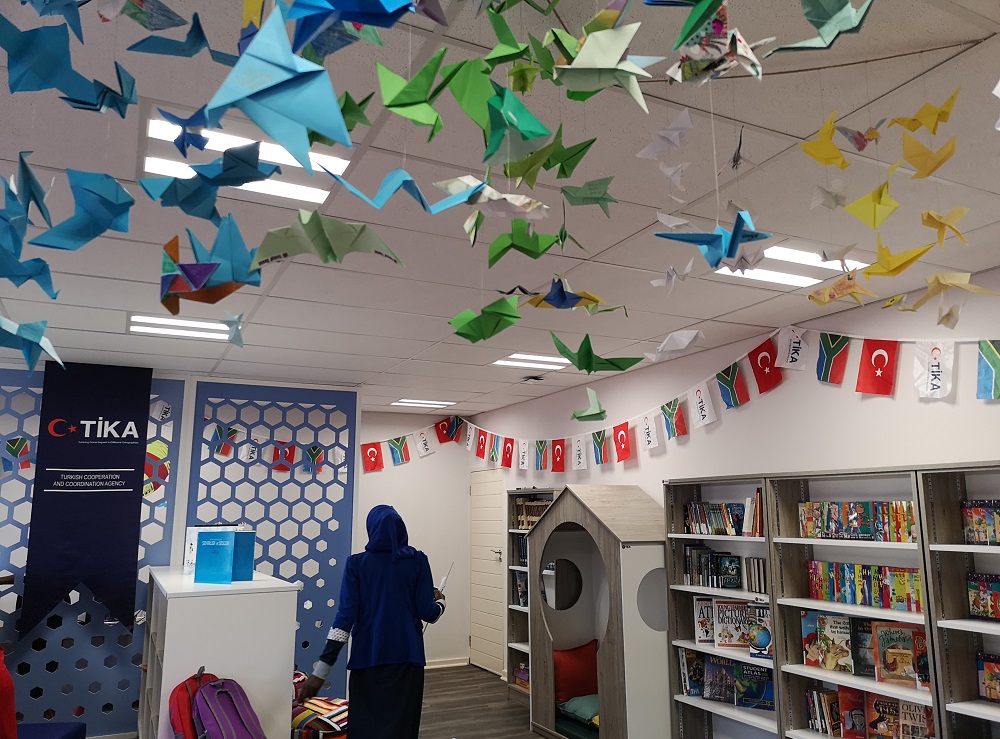
The library at Houghton Muslim Academy opened by Tika
Her husband, President Recep Tayyip Erdoğan was also in South Africa for the annual Brazil, Russia, India, China, South Africa (BRICS) summit. The First Lady said Turkey and South Africa share “deep-rooted” and “profound” ties. “I hope that seeds that we will be spreading today will reinforce our future relations, may our friendship be everlasting” she said. As part of the agreement with HMA, the school will add the Turkish language to it’s syllabus.
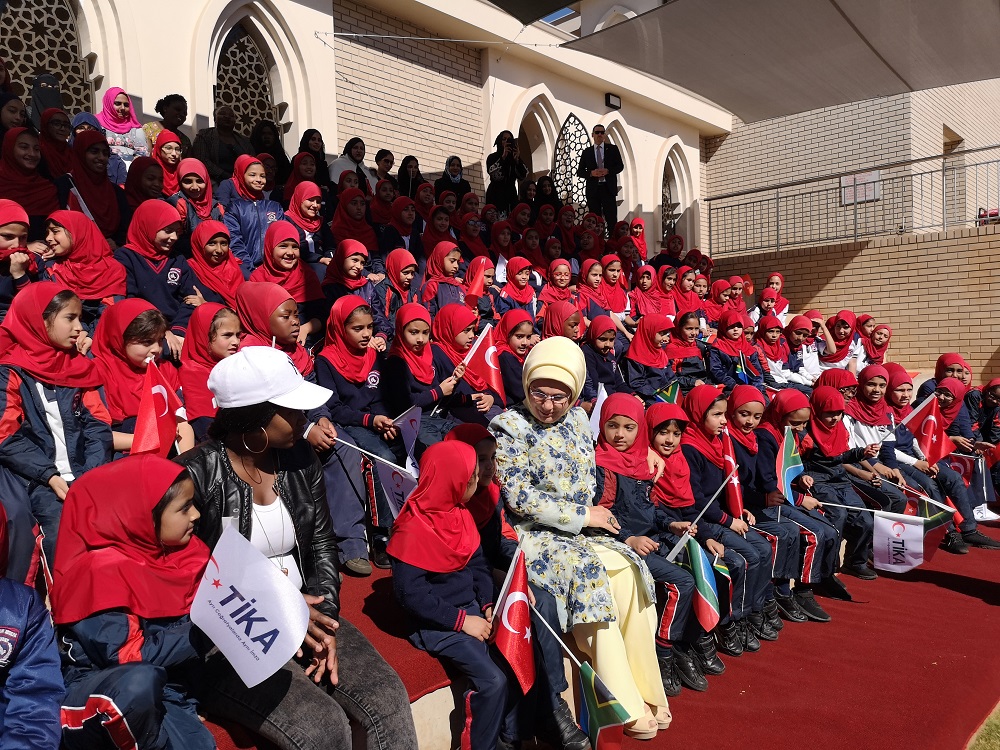
Turkish First Lady Ermine Erdogan poses for a picture with the pupils of Houghton Muslim Academy
The Turkish Cooperation Agency (Tika) is the Turkish government arm that provides development aid. Tika also seeks to neutralise another Turkish movement that has been establishing schools and institutions across the country: the Hizmet movement linked to the exiled Turkish Muslim cleric Fethullah Gülen Fethullah Gülen and Hizmet
A network of schools inspired by Gülen operates around the world, often attracting the children of local elites. Gülen’s movement Hizmet, inspired by his teachings, is a Sufi-inspired network of Turkish Muslims dedicated to promoting education, peace and interfaith dialogue. Once supported by the Turkish government, Hizmet enjoys a massive following in Turkey and various parts of the world. South Africa is no exception.
In South Africa, the Gülen movement has established nine schools, as well as the Turquoise Harmony Institute, an inter-faith centre. Nizamiye mosque in Midrand, a prominent landmark, was built by one of Gülen’s most loyal followers.
Hizmet networks among schools, businesses, think-tanks and publications help sustain the movement financially, researcher at the Afro-Middle East Centre (Amec) Matshidiso Motsoeneng said in an interview with The Daily Vox. The movement also has great influence on members of the Turkish political and professional elite which finances it. Additionally, Gülen’s businesses in the United States (US) where he resides are connected to big corporations there.
After the attempted coup in Turkey in July 2016, Erdogan and his Justice and Development Party, abbreviated officially AK Parti (AKP) in Turkish, banned activities linked to Gülen. The Turkish government established the Maarif Foundation in 2016 to take over the administration of overseas schools linked to the Gülen movement. This indicates that it perceives the existence of these schools as a real threat of Gülen’s influence and power.\
The Erdoğan-Gülen conflict
Erdoğan’s gripe with Gülen started years back. The president blamed the botched 2016 coup attempt in Turkey on a faction in the military allied to Gülen, who was once an Erdoğan supporter. Gülen denied all allegations and said Erdoğan has become increasingly authoritarian.

But the conflict began before that in 2010. “Gülen criticised Erdogan’s criticism of Israel and also criticised Turkey’s breaking off dip relations with Israel after the Mavi Marmara incident,” Motsoeneng said.
After that, Gülen criticised the AKP for trying to broker peace agreements with the outlawed Kurdistan Workers Party known as the PKK. Then in 2013, corruption allegations were levelled against Erdoğan’s supporters in government which included his son Bilal. The allegations were blamed on Gülen supporters in the police force and the judiciary. This subsequently led to allegations that he was involved in the 2016 attempted coup, Motsoeneng explained.
South Africa-Turkey relations
Despite the First Lady’s talk of the “deep-rooted” and “profound” ties between South Africa and Turkey, this is untrue. The countries do not enjoy very close relations even though recent efforts look set to achieve this, Motsoeneng said.
President Erdoğan himself warned that the Gülen group could infiltrate state institutions in parts of the world where it operates. The president and his AKP party maintain that Gülen institutions are not impartial and apolitical but rather serve an agenda promotes Gülen following and undermines Turkish sovereignty, Motsoeneng said.
“A lot of these accusations levelled against the Gülen schools have not been proven in South Africa even though Erdoğan has submitted documents to the government relating to them,” she said. However, South Africa does not regard the movement as a terrorist group or as posing any official threat to the country.
The Hizmet schools have existed in South Africa for quite some time, without much opposition. However, Motsoeneng said the schools are not apolitical. “They have been vocal about political issues taking place in Turkey as well as Turkey’s presence and relations with South Africa,” she said.
Tika, on the other hand, has been widely used to promote Turkish cultural diplomacy in many parts of the world. “I think as the Turkish push against the schools and institutions linked to the Hizmet intensifies, we will see more of the fight off between the two,” Motsoeneng said. “Whether or not this will impact South Africa remains to be seen as Turkey hopes to establish itself more in southern Africa,” she added.

http://www.thedailyvox.co.za/the-erdogan-gulen-proxy-conflict-in-south-african-schools-shaazia-ebrahim/

Monday, April 29, 2013

Gulen Schools Worldiwde, Tally of Gulen Schools outside of Turkey


Turkish News Magazine Yeni Aktuel's 2005 Tally
of Gulen Schools outside Turkey
 
Footnote:  This list is already over 7 years old and the Gulen Schools have increased in number AND CONTROVERSY. 


In 2005, prominent Turkish news magazine Yeni Aktuel published an article (in Turkish) entitled "Gulen's Educational Empire." It can be viewed at the Haber10 website. In this article, a tally is given of Gulen schools outside of Turkey. The schools are not named, but their number is listed by country. A translation of this list is given below.

Note that a number of Gulen charter schools were already in operation in the U.S. in 2005 (see the Perimeter Primate blogger's timeline), but are not counted in this list. It is unclear whether Yeni Aktuel simply did not know of their existence, or if their omission was a "courtesy" to the Gulen Movement.

It is often said that the Gulen schools in Russia were closed, but the mention on this list of 6 schools in the Russian Federation is consistent with our observations that Gulen schools are in operation in that country. The closure was temporary, as confirmed in the doctoral dissertation of Mustafa Gokhan Sahin (Florida International University, 2010).

The mention of one school in Uzbekistan is also noteworthy. The Department of State's religious freedom article on Uzbekistan (accessed Dec 2012) says that all "Turkish schools" (referring to Gulen schools) were closed in 1999. Several other sources refer to this closure; Radio Free Europe/ Radio Liberty wrote that
"In 1999, Tashkent closed all Turkish lyceums after its relationship with Ankara turned sour." However, a Today's Zaman article of Jan 19, 2011 reports the closure of the Tashkent Ulugbek International School. Most likely this is the one school referred to in Yeni Aktuel's list.

There has been substantial expansion of the international school network since 2005.

North America
Canada: Language class.
Mexico: 1 school and cultural center.
U.S.: 5 private schools, more than 50 cultural centers.

South America
Argentina: 1 cultural center.
Bolivia: 1 cultural center.
Brazil: 1 cultural center.
Chile: 1 cultural center.
Colombia: 1 cultural center.

Europe
Azerbaijan: 12 schools.
Georgia: 3 schools.
Russian Federation: 6 schools.
Ukraine: 2 schools.
Moldova: 2 schools.
Lithuania: 1 cultural center.
Latvia: 1 cultural center.
Estonia: 1 cultural center.
Romania: 4 schools.
Bulgaria: 3 schools.
Macedonia: 4 schools.
Albania: 4 schools.
Bosnia and Herzegovina: 2 schools.
Hungary: 1 language school, 1 cultural center.
Slovakia: 1 cultural center.
Czech Republic: 1 cultural center.
Poland: 1 cultural center.
Germany: 3 schools, language schools and cultural centers.
Austria: 1 language school.
Italy: 1 cultural center.
Switzerland: Student dormitory and cultural center.
Netherlands: Student dormitory and cultural center.
Belgium: Student dormitory, language school and cultural center.
France: Cultural center and language courses.
Denmark: language class and cultural center.
Belarus: 1 language school.
Norway: language class and cultural center.
Sweden: language class and cultural center.
Finland: 1 "college" (=college-preparatory high school), language class and cultural center.
UK: Student dormitory, language school cultural center.
Portugal: 1 cultural center.
Spain: Cultural center and language class.

Africa
Morocco: 4 schools.
Algeria: Language school.
Egypt: Language school and student dormitories.
Mauritania: 1 school.
Mali: 1 school.
Niger: 1 school.
Chad: 1 school.
Sudan: 2 schools.
Ethiopia: 1 school.
Senegal: 1 school.
Gambia: 1 school.
Guinea-Bissau: 1 school.
Guinea: 1 school.
Burkina Faso: 1 school.
Ghana: 1 school.
Togo: 1 school.
Nigeria: 4 schools, cultural center.
Cameroon: 1 school.
Central African Republic: 1 school.
Congo: 1 school.
Uganda: 1 school.
Kenya: 4 schools.
Tanzania: Education complex (Including outpatient clinic, sports halls, primary school and high school).
Malawi: 1 school.
Mozambique: 1 school.
Madagascar: 1 school, 1 cultural center.
South Africa: 4 schools.

Asia
Kazakhstan: 29 schools.
Tajikistan: 13 schools.
Kyrgyzstan: 12 schools.
Turkmenistan: 20 schools.
Uzbekistan: 1 school.
Afghanistan: 4 schools.
Pakistan: 6 schools, 1 cultural center.
India: 3 schools, 1 language class.
Nepal: 1 school.
Bangladesh: 4 schools.
Mongolia: 4 schools.
Japan: 1 school, 5 language schools, cultural centers.
South Korea: 1 cultural center.
Malaysia: 1 school.
Vietnam: 1 school.
Cambodia: 2 schools.
Burma: 2 schools.
Thailand: 3 schools.
Iraq: 4 "colleges" (=college-preparatory high schools).
Israel: cultural center.
Yemen: 1 school.

Oceania
Australia: 7 schools.
Indonesia: 4 schools.
Philippines: 4 schools.


Monday, October 15, 2012

Gulen Turkish School in Nigeria, Africa closed Turkish International School

We are told that the Gulen population operates more than 1 Turkish school in Nigeria.  So this information is rather vague.  But it seems the boys have not been following the rules of the country (surprise surprise)  and was closed along with 29 other schools.

http://www.peoplesdaily-online.com/index.php/news/news/national-news/5155-kano-shuts-down-turkish-international-school-29-others

The Kano state Private Schools Task Force constituted by the state government has closed down the famous Nigerian/Turkish International Schools and 29 others for violating the rules and regulations governing the educational activities of the state.
The taskforce committee chairman, Alhaji Baba Umar, announced the closure of the schools while briefing newsmen in Kano yesterday.
He explained that the closure of the schools became necessary because the management of the affected schools refused to comply with government regulations governing the operation of private schools in the state.
He said other reasons for the action include indiscriminate increase of school fees without following the approved processes and lack of well-stocked laboratories/libraries in case of secondary schools.
Others are non-functional academic records, log book, register, visitors’ book, syllabus and scheme of work books among others.
He warned that the schools would not be reopened until they fully comply with the directives.
Baba also hinted that most of the affected schools were operating without provisional approval/ certificates